The following text is taken from a moving report of two parishioners' visit in August 2004:-
|
On 25th August, I and a fellow Clare Priory parishioner, Camilla Whitehouse, flew to Nairobi in Kenya. For both of us it was to be our first trip to Africa! Following a long (but comfortable) flight, we finally arrived at Kenyata airport, tired, nervous, excited and perhaps a little bit scared about what the following few days would bring. Waiting outside to meet us, and perhaps feeling just as apprehensive, was Fr Mike Bazza from the Church of the Sacred Heart in Babadogo, one of the poorest slum areas in Kenya. Alongside Fr Mike were no less than ten church officials and two little girls, each dressed in their best (their only?) white dress and carrying a bunch of roses for us. Ten minutes and lots of kisses and hand shakes later we were on our way from the city centre with its high rise offices and international banks to the dark back streets and litter strewn dirt-track roads that is Babadogo. The next morning, we were able to get our first real look at Babadogo. |
|
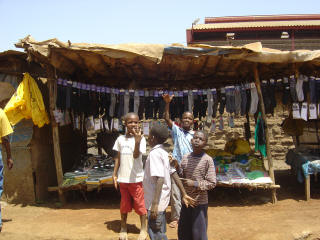 |
The first street we walk down is lined on each side with make-shift market stalls, thrown together from whatever can be salvaged from the rubbish dumps, tiny 'shops' where it’s possible to buy anything from socks to chapattis. |
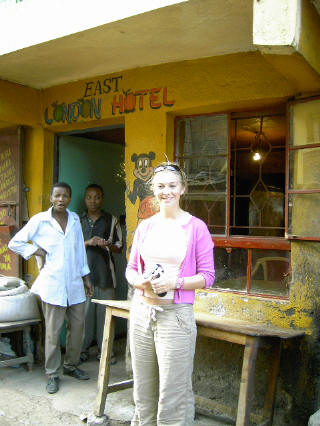
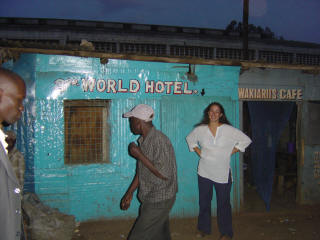
| Here and there are shacks built from brightly painted corrugated steel sheets, these are the hairdressers and bars, with such names as the Third World Hotel and the East London Hotel - complete with a painting of Mickey Mouse on the doorway! |
 |
 |
|
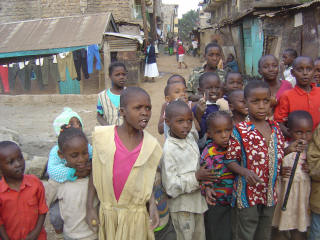 |
Going further into the slums the route becomes increasingly difficult under foot. Everywhere we turn our steps are hampered by swarms of children. Like mice coming out of the woodwork, they run everywhere, flashing smiles of beautiful white teeth in faces dirty with un-wiped noses and the ever present dust that stings your eyes and makes you cough with each breath |
| The agility of these children is amazing, little tots barely old enough to be out of nappies scurrying along and climbing up and down the slippery and uneven paths. If anyone falls, dozens of hands stretch out to help. They all want to hold our hands or have their photograph taken. | 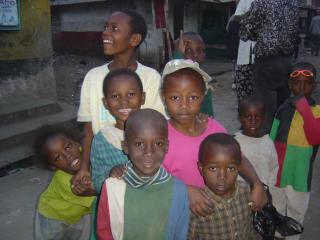 |
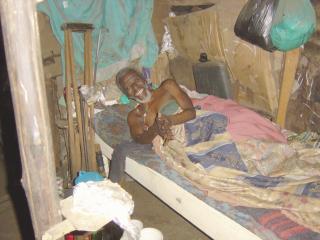 A little further on Benson,
our guide, takes us into a tiny shed made from tin sheets. Inside it is
pitch-dark. Benson introduces us to its occupant; a man lying in his bed.
I cannot see him, but the infirmity of his voice gives a clue to his age.
We ask to take his photograph, but he won’t allow us until he has put his
rosary around his neck. I sit on his bed shaking his hand whilst Benson
points the camera in the right direction! Now I can look at the picture to
see who I’m talking to (thank God for digital cameras). There I am holding
hands with a frail elderly gentleman whose smile outshines any other I have
seen. Wooden crutches are propped up against the wall, no wonder he didn’t
get up to greet us! A little further on Benson,
our guide, takes us into a tiny shed made from tin sheets. Inside it is
pitch-dark. Benson introduces us to its occupant; a man lying in his bed.
I cannot see him, but the infirmity of his voice gives a clue to his age.
We ask to take his photograph, but he won’t allow us until he has put his
rosary around his neck. I sit on his bed shaking his hand whilst Benson
points the camera in the right direction! Now I can look at the picture to
see who I’m talking to (thank God for digital cameras). There I am holding
hands with a frail elderly gentleman whose smile outshines any other I have
seen. Wooden crutches are propped up against the wall, no wonder he didn’t
get up to greet us! |
|
| It is very humbling to meet people who have so, so little and yet are so proud of what they have. Where is the blatant consumerism that we live with every day, the ‘I want it all and I want it now ethos that seems to pervade our lives? (I wonder what these people would make of the famous shampoo advert that tells us we should buy their product ‘because we’re worth it’). Our tour of the slums draws to a close. It’s very dark here at night, no street lights, no official electricity supply to the houses, although some reckless (desperate) individuals run taps from the main overhead power cables to power the few electrical items they own. | 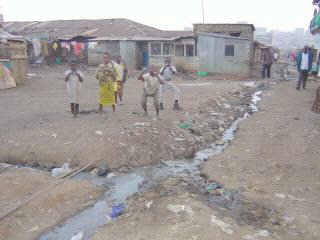 |
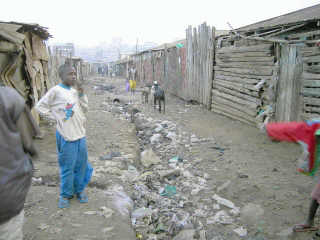 |
Back in the safety and absolute luxury (by comparison) of the church compound, both Camilla and I found it hard to believe that anyone could be expected to live their life in such squalor, and were appalled by the idea that the people we had met were actually paying rent to live in such conditions. I had a mental image of a fat and greedy landlord who lived off of the extortionate rents charged for living in squalor. Benson told us later that one of the ladies we had met in the slums owned six such properties. |
To be charitable is an easy thing when you have so much. I am lucky. I can afford the luxury of giving a bit of money to charity. I’m guilty of having boasted to others about how much I give each month. But are there any real sacrifices involved in ‘doing my bit’? Of course not, after all I make sure that my family have what they need first! If anything, giving to charity is more about easing my guilty conscience at having so much when others have so little than it is about genuinely giving; I wonder how many others amongst us do the same.
In conclusion, I have learned some valuable lessons from my brief visit to one of Africa’s wealthier nations: For many, including me, giving time and effort to help a cause is a far greater sacrifice than giving cash, and a much harder one to make. I will never congratulate myself again for putting a few coins in a collecting tin and hoping that someone else will sort out the problems of the world so I don’t have to.
Be proud of what little you have and value the important things in life, your family, your health. Don’t keep looking for more ‘stuff’, that’s all it is, ‘stuff’! If all you ever want is more, you’ll never be satisfied.
Text © 2004 Julie Charton, and photos © 2004 Camilla Whitehouse and Julie Charton